
 Our Location
1st Floor, A3/15, Main Road, Paschim Vihar, New Delhi - 110063
 +91- 9310999214
Call for free consultation
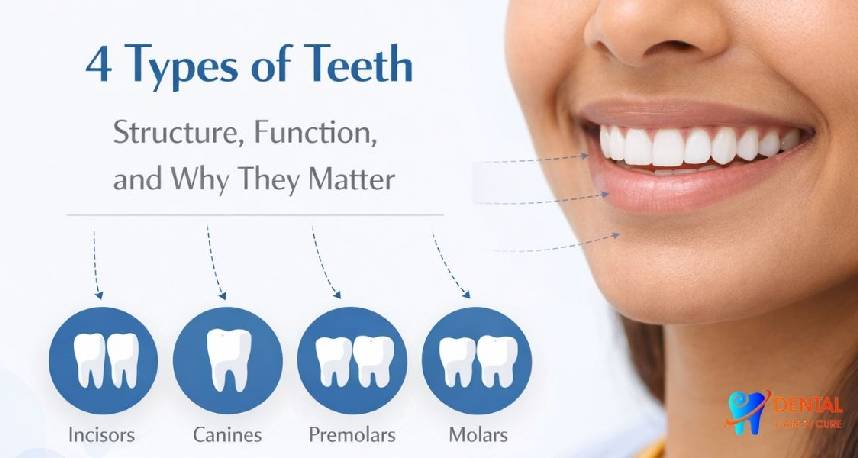
4 Types of Teeth: Structure, Function, and Why They Matter
If you’ve ever wondered why your mouth has teeth that look slightly different from each other, you’re not alone. Understanding the types of teeth is not just biology exam stuff, it actually explains how you chew, speak, and even smile confidently. If you are looking for dental care or guidance, clinics like Best dental clinic in Paschim Vihar (Dental Care 'N' Cure) often educate patients about oral structure before treatments like Smile Makeover treatment in Paschim Vihar. Your teeth are not randomly placed tools. They are a well-organized system designed for efficiency, balance, and survival. Let’s break down everything in a simple, logical, and human way.
What Are the Types of Teeth in Humans?
Humans have four types of teeth in human dental anatomy, and each plays a specific role in digestion and speech.
- These include:
- Incisors
- Canines
- Premolars
- Molars
This classification of human teeth is part of human dental anatomy and is essential for understanding tooth morphology and function. In simple words: your mouth is basically a teamwork system where every tooth has a job, no freelancing allowed.
How Many Types of Teeth Do Humans Have?
A fully developed adult has 32 permanent teeth, divided across the four types of teeth. So when someone asks how many types of teeth exist, the answer is not just about count, it’s about function-based classification. This system belongs to the permanent dentition stages, which replace the primary (baby) teeth set. Humans don’t just “grow teeth”; they upgrade them like software versions.
Also Read: How to Prepare for the First Dental Appointment in Delhi – Here’s What to Expect
The 4 Types of Teeth and Their Functions
Let’s understand the 4 types of teeth and their functions in detail.
Incisors – The Cutting Tools
Incisors are the front teeth. You have 8 of them.
- Function:
- Cutting food
- Helping with speech clarity
- Supporting facial structure
These teeth are sharp and straight, designed for slicing food like carrots or apples. In terms of tooth structure in humans, incisors are the first point of contact during biting. They play a key role in the mastication process in humans. Think of them as tiny scissors, minus the safety guard.
Canines – The Tear Specialists
Canines sit next to incisors. You have 4 in total.
- Function:
- Tearing food
- Holding and gripping
- Guiding jaw alignment
These are pointed teeth designed for tougher food textures. From a dental anatomy and tooth function perspective, canines help stabilize the bite and support occlusion and bite function. Basically, they are the “power tools” of your mouth.
Premolars – The Crashing and Grinding Team
Premolars sit between canines and molars. You have 8 premolars.
- Function:
- Crushing food
- Initial grinding
- Supporting chewing efficiency
They combine the functions of canines and molars. This is where the role of different teeth in chewing and digestion becomes important. Premolars prepare food for final grinding. If teeth had a gym team, premolars would be the CrossFit trainers.
Molars – The Heavy Grinders
Molars are the largest teeth at the back. Adults typically have 12 molars, including wisdom teeth.
- Function:
- Grinding food thoroughly
- Breaking down tough textures
- Completing digestion preparation
Molars are essential for proper digestion because they reduce food into small, swallowable particles. In human dentition types, molars carry the highest workload. Without them, your digestive system works overtime.
Understanding Tooth Structure in Humans
- Each tooth has a layered structure:
- Enamel (hard outer shell)
- Dentin (middle layer)
- Pulp (nerves and blood supply)
This oral cavity structure ensures durability and sensitivity control. Enamel is the hardest substance in the human body. Yes, even harder than bone. But it still hates sugar like everyone else.
Why Different Types of Teeth Matter
The types of teeth and their functions are not random, they are evolution-based design features.
- Here’s why they matter:
- Efficient Digestion: Chewing properly reduces strain on the stomach.
- Speech Clarity: Incisors and tongue interaction shape pronunciation.
- Facial Structure: Teeth support jaw alignment and facial balance.
- Bite Function: Proper occlusion and bite function ensures even pressure distribution.
Without all four types, chewing becomes inefficient and digestion slows down.
Tooth Morphology and Function Explained Simply
The shape of each tooth (tooth morphology) matches its job:
- Flat teeth = grinding (molars)
- Sharp teeth = tearing (canines)
- Chisel-shaped = cutting (incisors)
This natural design reflects millions of years of evolution in human dental anatomy. No engineering company could design this better without calling it “premium biomechanical engineering.”
Common Dental Alignment Issues and Solutions
Not everyone has perfect alignment of teeth types.
- Issues include:
- Crowding
- Gaps
- Misaligned bite
- Modern dentistry solves this using:
- Teeth Aligners Treatment in Paschim Vihar
- Invisible braces in Paschim Vihar
Clinics like Best dental clinic in Paschim Vihar (Dental Care 'N' Cure) often recommend these treatments after analyzing bite structure and tooth function.
How Teeth Work Together During Chewing
The mastication process in humans involves coordination:
- Incisors cut food
- Canines tear it
- Premolars crush it
- Molars grind it
This teamwork ensures smooth digestion. Think of it as a factory line, but in your mouth.
Importance of Understanding Your Teeth Types
Knowing your types of teeth in human body helps you:
- Maintain better oral hygiene
- Understand dental treatments
- Prevent long-term issues
- Appreciate your bite function
It also helps when discussing treatment options like Smile Makeover treatment in Paschim Vihar or orthodontic corrections.
Dental Health and Professional Care
Regular dental checkups ensure:
- Proper alignment
- Healthy enamel
- Early detection of decay
If you are searching for guidance or treatment, Best dental clinic in Paschim Vihar offers structured care plans based on tooth function and structure. Good dental care is not just about fixing problems, it’s about understanding them early.
Why Understanding Teeth Types Improves Dental Health
A good example of natural design that is in harmony is the kind of teeth that humans have. The different types of teeth serve their purpose in chewing, speaking and keeping the mouth healthy. We have incisors, molars; every tooth plays a bigger role in your daily life than you can imagine. Next time you take a bite into something, remember, it is not eating. It’s a coordinated biological performance.
In case you have some dental problems or even wish to learn more about your oral health, there is no need to wait; call Dental Care 'N' Cure. Call now or schedule your appointment and get professional advice and individualized dental treatment to maintain your smile healthy and confident.